The Legislature has sent a bill to Gov. Brown that would save hospitals from a major cut in reimbursements for treating disabled people under the Medi-Cal program. In exchange the hospitals have agreed implement a fee program that will bring the state $2.4 billion a year in federal healthcare funding.
Public Health
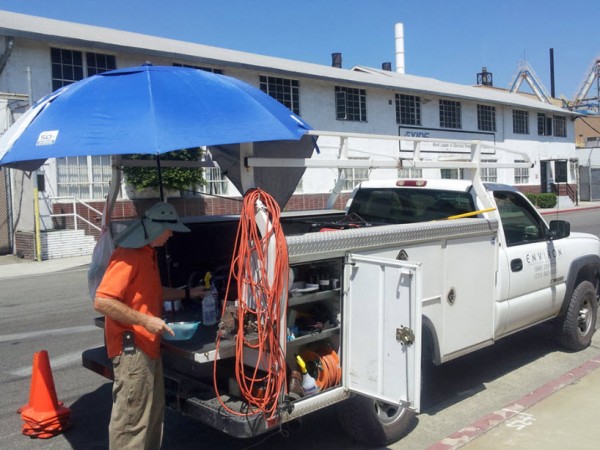
As state-ordered testing of the soil around a battery recycling plant gets underway in a low-income neighborhood just east of downtown Los Angeles, activists say they already know what the tests will show.
A scourge in much of the world, tuberculosis has long been declining in this country. But TB has persisted among the homeless. And on Los Angeles’ Skid Row, where close quarters and unsanitary conditions help spread the disease, it’s made an alarming advance.
Twenty-year-old David Navarrete tried to slit his wrists four years ago, in the grip of severe depression, a condition he inherited from his mother. Luckily he survived and got therapy – first from the Barbara Sinatra Children’s Center in Rancho Mirage, and then from the Harmony Center – a mentoring program at the Oasis Community Services in Indio.
The Southern California International Gateway (SCIG) BNSF Railway wants to construct a new rail yard a few miles from the Port of Long Beach, enabling a large volume of trucks to load containers onto trains closer to the ports of Long Beach and Los Angeles and angering residents who say their neighborhood already suffers from poor air quality.
Obesity rates are finally turning around in low-income preschoolers. After a generation of steady or increasing obesity rates, new data shows that obesity is down in low-income kids ages 2 to 5 in California and eighteen other states, according to a report released by the Center for Disease Control and Prevention.
Public policy affects all of our daily lives, but vulnerable populations feel the consequences of policy most acutely. In this issue, focused on children’s health, we take a look at how policy is affecting the most vulnerable kids in our state.
As California cuts spending on anti-smoking programs and tobacco companies boost their marketing campaigns, young Californians are reaching for cigarettes in increasing numbers.
Despite the fact that there is some money available for interim fixes and emergency drinking water, many residents of disadvantaged communities throughout California have gone for years, sometimes decades, paying for both contaminated tap water and bottled water for drinking and cooking.
Small organic farms cropping up all over California are helping residents get back to their roots — and also their leafy greens and vitamins. The first two community-supported agriculture ventures began on the East Coast in 1986, and since then, the number of community-supported farms across the country has grown exponentially as word of mouth travels.