By Minerva Perez
One California county needed to make some quick adjustments to accommodate the low-level offenders newly under their supervision since last year, when prison realignment started.

By Minerva Perez
One California county needed to make some quick adjustments to accommodate the low-level offenders newly under their supervision since last year, when prison realignment started.
In the shadow of USC and close to a new light rail line, property in the northern portion of South L.A. couldn’t be hotter. Older homes and apartment buildings have been refurbished and rented to students at much higher rates than typical long-time working-class South L.A. families can afford. And new development is expected with the introduction of the Expo Line, making buildings like Rolland Curtis Gardens all that more attractive.

By Jessica Chang
For Terri Soares, Merced City School District Nutrition Services Director, it’s all about making the food familiar to students – from its taste to its shape. “Merced city kids have 4 flavor profiles that they know – fat, sugar, salt and fast food,” she said. “And unfortunately, introducing anything outside of those flavor profiles, [they need to become] accustomed to it.”

By Mary Flynn
Larry Romer wants a better future for his son and his hometown in Hayward. The 44-year-old grew up in a neighborhood known as the Jackson Triangle, a diverse and low-income area. Larry stays involved in the community – he tutors school children, coaches baseball and sits on a school committee at his son’s school – but despite his own efforts or the efforts of others, the schools and the neighborhood have deteriorated.
But thanks to the successful collaboration of several civic and community agencies, Romer’s old neighborhood, one of Hayward’s most vulnerable, has been awarded a momentous grant from the Department of Education that will provide nearly $25 million dollars in support services and programs over a five-year period.

The Community Hospital of the Monterey Peninsula recently received a gold seal of approval from the Joint Commission for its advanced inpatient diabetes care. It is one of six hospitals to receive the certification in California, and one of 41 in the nation.
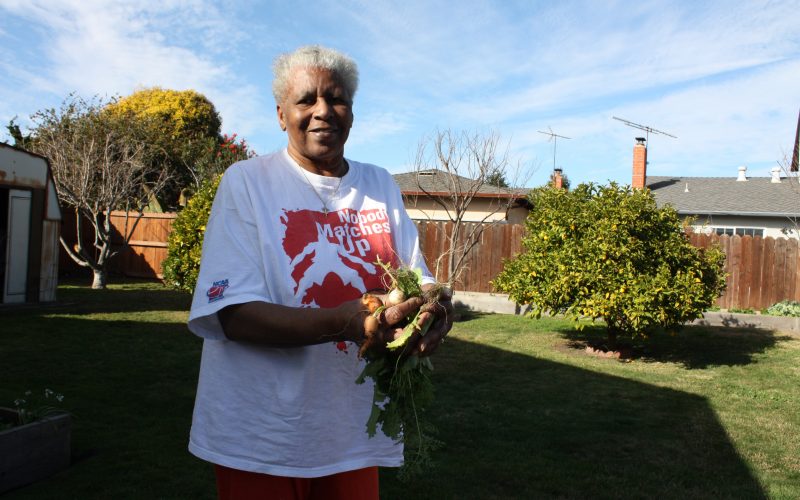
Urban agriculture is the latest craze, from the White House to Berkeley. But some urban residents have been growing their own food for years, long before it was cool. Rosa Ramirez has the story.
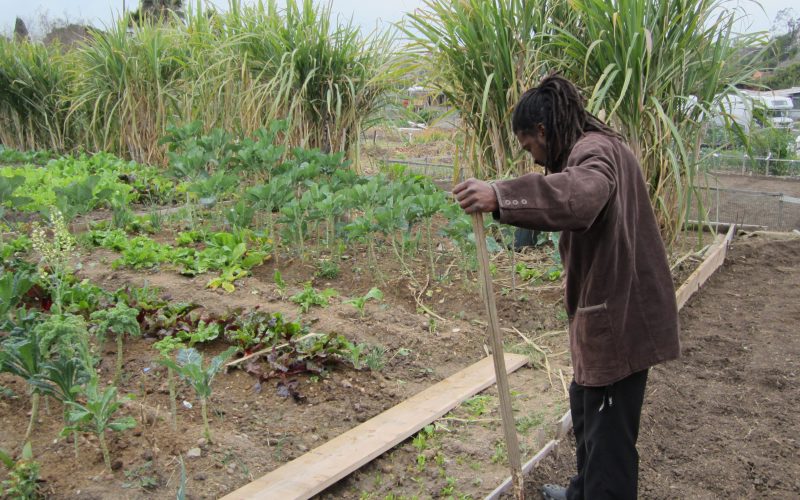
San Diego has joined the urban agriculture movement. What started as a nonprofit group’s entanglement with bureaucracy while trying to plow a community garden in an impoverished neighborhood has ended with California’s second-largest city relaxing its rules on farmers’ markets and making it easier to grow crops and keep chickens and goats in residential areas.
The House of Peace opened a year ago and has 13 residents as well as four house coordinators who live together in a community. To be accepted into the home, residents who are formerly homeless have to volunteer five days a week for about 20 hours a week. Residents have to pass a drug test to show that they are not using, complete a background check that looks for sexually-related crimes and they agree to follow the house rules peacefully. When a room opens up, the residents vote on which applicants to accept into their community.
By Clare Noonan
On a beautiful winter Sunday, the street in front of Merced Lao Family Community Inc. was full of wondrous sound. Atonal yet haunting tunes were coming from the curved reeds of the qeej (pronounced “kang”) played by 25 boys and young men of Hmong ancestry.
The Alliance for California Traditional Arts, based in Fresno, thinks that practicing such traditions is a big part of community health – and they commissioned a study from UC Davis that suggests they are correct.
By Mary Flynn
The city of Richmond is attempting to pass a proposal that’s failed in big cities including New York City and Philadelphia – and if they succeed, their plan could encourage statewide changes in California.