With the state facing a $15.4 billion budget shortfall, social programs across California are cutting costs by limiting eligibility. So why are state lawmakers voting to enroll more people in CalFresh, the state’s food stamp program, if there’s not enough money to go around? Lawmakers say an expanded food stamp program may actually help improve the economy at no cost to the state’s ailing general fund — though taxpayers in California and elsewhere will continue to foot the bill for the federally funded program.
Public Health
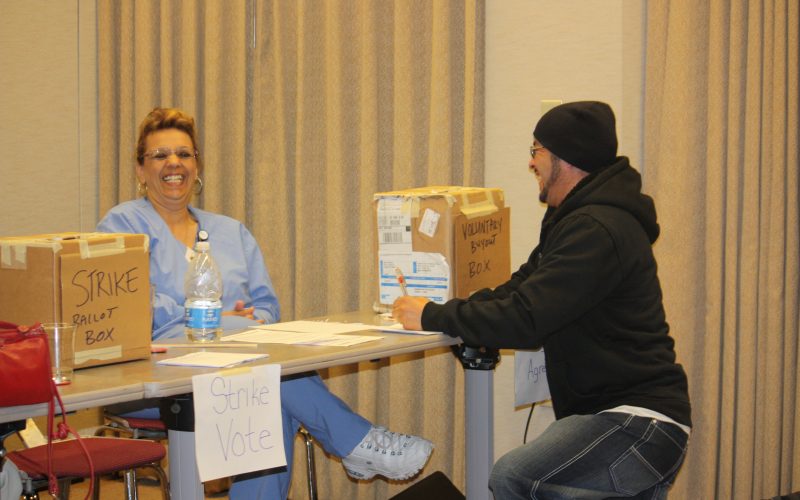
National Union of Healthcare Workers has struggled to make that case to the state’s healthcare workers ever since it broke from the Service Employees International Union, the nation’s largest labor union, two years ago in a dispute over local control and governance. But now, in Salinas, the union has another chance to prove itself, if it can win a solid contract and block lay-offs.
Merced County, like the rest of California, is home to a growing population of ethnic minorities. The county also offers a glimpse into the future, a window onto how healthcare services might need to change to address the needs of a changing community.
Under Gov. Arnold Schwarzenegger, state funding for HIV and AIDS programs was cut by more than half, $85 million, in the 2009-10 fiscal year. That included the entire budget for HIV prevention and testing, though about $12 million in federal funds was still available. That trend has continued since then, and no state funding for prevention and testing is proposed in the next fiscal year either under Gov. Jerry Brown’s budget as California continues to face a financial meltdown.
Today the California Assembly Health Committee will hold a hearing on a bill that would allow state regulators to reject health insurance rate increases deemed excessive or discriminatory. This hearing will come just six days after the first board meeting of the California Health Benefit Exchange. Many hope that the Exchange will take the lead in holding insurance rate increases down through actively negotiating with insurers. Can active negotiation work in tandem with rate regulation?
As the economy has expanded and contracted over the past three decades, Californians have slowly, but steadily, paid more in personal income taxes to support state government. Corporations, however, are another story. While individuals have watched their tax burden rise, corporations have seen their effective tax rate plummet even as California-based companies like Chevron, Google and Apple have posted record profits. This disparity has reinforced the state’s reliance on personal income tax and contributed to California’s chronic budget deficit.
California’s perpetual budget battles center around the $85 billion “general fund” used to pay for schools, prisons and health welfare services. But separately there are more than 400 little-noticed accounts called “special funds” that together will spend nearly $30.5 billion in 2010-11, according to Department of Finance records.
While Gov. Jerry Brown and lawmakers wrestle with the budget crisis, some Californians are adamant that much of the problem can be laid at the feet of people who are in the country illegally. Their message is: stop teaching the kids, cut-off welfare checks and ship the prisoners back home. That way, billions of dollars spent on services could be put to work cutting the deficit, paying for vital programs and keeping tax increases at bay. But that’s easier said than done.
In California’s state Capitol, they call it counter-cyclical, a mundane term used to describe the volatile rollercoaster effect of a bad economy on government-run social programs. As the economy and tax revenues decline, demand for many state-run programs increases, putting more stress on the budget just when it can handle it least. The grand daddy of all counter-cyclical programs: Medi-Cal, the state and federal program that provides health care for the poor.
In Salinas, health officials could soon issue a new warning: Don’t even think of applying for a job at the Monterey County health department or the county hospital, Natividad Medical Center, if you smoke.